”Search is changing. It’s no longer just about ranking on Google, ; it’s about being understood, cited and recommended by search engines and AI tools alike. Whether someone is searching through Google AI Overviews or AI Mode, ChatGPT, Perplexity or Gemini, structured data helps machines understand exactly what your content is and why it deserves to be shown” – Annie Broadhurst, SEO Specialist.
What is Structured Data?
The definition of structured data is information added to a website in a machine-readable format that helps search engines and AI systems understand the content of a page.
It’s where data on a website isorganised according to a recognised framework, usually using Schema.org vocabulary and JSON-LD markup.
Instead of making Google guess whether a page is a blog, product, service or FAQ, schema and structured data explicitly tell search engines what the page represents and how it should be used in search results
Did you know? Schema.org is a common language for websites and search engines. It was launched by Google, Bing, Yahoo and Yandex in 2011 to unify their varying structured data approaches, creating a shared standard for website owners and businesses to follow.
Why Structured Data Matters for SEO and AI
For years, structured data and SEO have gone hand in hand. Structured data can enhance search listings with rich results such as:
- Star ratings
- FAQs
- Product pricing
- Availability information
- Breadcrumb navigation
Click here for a list of structured data markup that Google supports
However, the role of structured data for LLMs is becoming even more important.
Large Language Models (LLMs) such as ChatGPT, Claude, Gemini and Perplexity use structured signals to understand content and identify trustworthy sources. Research highlighted by Neil Patel found that pages using structured content were cited significantly more often by AI tools than pages relying purely on unstructured information.
The relationship between LLMs and structured data is simple: the clearer your website communicates information, the easier it is for AI systems to trust, reference and surface your content.
Below is the findings of a study done by Neil Patel, a globally renowned digital marketing expert. This table below shows the % of answers coming up in the top results found in these platforms which had structured data.
| LLM | Structured Content | Unstructured Content |
| ChatGPT | 72% | 28% |
| Claude | 63% | 37% |
| Perplexity | 91% | 9% |
| Gemini | 74% | 26% |
Types of Structured Data You Should Be Using
There are many types of data structured using Schema.org, but some of the most valuable for businesses include:
- Organisation
- Local Business
- Product
- Article / Blog Posting
- FAQs **
- Breadcrumb List
- Review
- Aggregate Rating
- Author
- Person
For ecommerce brands, product structured data is essential for displaying pricing, reviews and availability directly within search results.
For service businesses, LocalBusiness and FAQ schema can improve local visibility and support AI-driven answers.
** 2026 FAQ Schema update
Although Google has stopped the visual display of FAQ rich results in search results, FAQ Schema is still valuable and should remain part of your structured data strategy. While it may no longer generate the same SERP (search engine results page) enhancements it once did, FAQ Schema helps search engines and AI platforms such as ChatGPT, Gemini and Perplexity understand question-and-answer content more clearly. By structuring information in a format that machines can easily interpret, FAQ Schema improves content comprehension, supports Answer Engine Optimisation (AEO), and can increase the likelihood of your content being referenced or cited in AI-generated responses. In short, FAQ Schema is no longer primarily about earning rich results, it’s about helping search engines and AI systems better understand and trust your content.
Beyond SEO, FAQs enhance the user experience by providing quick, accessible answers to common questions.
How Structured Data Helps Google Trust Your Website
Author and Person Schema help Google understand who created your content and whether they are a credible source. By connecting articles to real individuals, qualifications and professional profiles, these schemas strengthen E-E-A-T signals (Experience, Expertise, Authoritativeness and Trustworthiness). For businesses investing in SEO and AI visibility, clearly identifying content authors through Person Schema and Author Schema helps Google, ChatGPT and other AI platforms attribute content correctly and build greater trust in your website.
Structured Data Markup Meaning and Example
The structured data markup meaning is simply code added behind the scenes of a website to describe content.
A basic structured data markup example for a business might identify:
- Business name
- Website URL
- Contact details
- Social media profiles
- Services offered
Google and easier to manage than older methods such as Microdata.
Structured data example
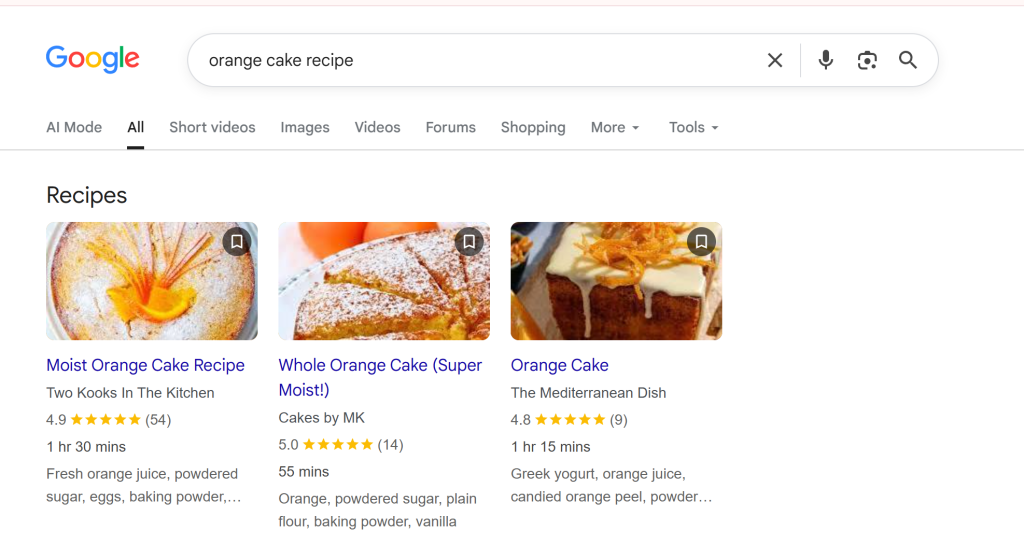
I have carried out a Google search for “orange cake recipe”. The example below demonstrates how structured data can enhance a website’s appearance in Googles rich results. In this instance, Recipe Schema and Review Schema have been implemented, allowing Google to display additional information such as star ratings, review counts, preparation time and other recipe details directly within the SERP. As you can see, the recipe with the highest number of reviews is ranking in the top organic recipe position, highlighting how structured data can improve visibility, increase click-through rates and make listings more appealing to users.
Googles rich results structured data example:
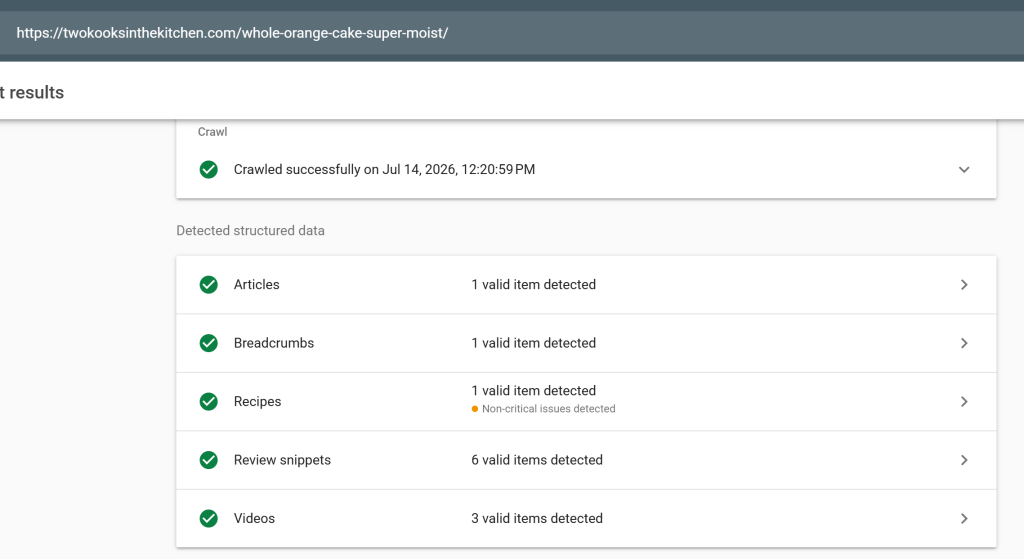
Rich results tester for the same cake recipe
When the same URL is tested in Google’s Rich Results Test, the Schema.org markup is successfully validated, confirming the page is eligible for rich results in search.
Schema markup code from the no.1 orange cake recipe
The below code is a snippet of the JSON-LD schema markup behind the same webpage. Look for the @type properties, which identify the different schema types being used to help search engines understand and categorise the page content.
| @type | Recipe |
| @id | https://twokooksinthekitchen.com/whole-orange-cake-super-moist/#recipe |
| name | Moist Orange Cake Recipe |
| description | This super moist orange cake is rich, tender, and full of fresh citrus flavor. Made with whole oranges and simple pantry ingredients, it’s easy to prepare in a food processor and delicious plain or topped with orange buttercream. |
| datePublished | 2021-12-21T13:26:00+00:00 |
| image | https://twokooksinthekitchen.com/wp-content/uploads/2026/01/orange-cake-recipe-3.jpg |
| image | https://twokooksinthekitchen.com/wp-content/uploads/2026/01/orange-cake-recipe-3-500×500.jpg |
| image | https://twokooksinthekitchen.com/wp-content/uploads/2026/01/orange-cake-recipe-3-500×375.jpg |
| image | https://twokooksinthekitchen.com/wp-content/uploads/2026/01/orange-cake-recipe-3-480×270.jpg |
| recipeYield | 12 |
| prepTime | PT10M |
| cookTime | PT50M |
| totalTime | PT1H30M |
| recipeIngredient | 2 large seedless oranges (about 184g each) |
| recipeIngredient | ¾ cups butter, cut in chunks (1½ sticks) |
| recipeIngredient | 1 ¼ cups granulated sugar ((use an extra ¼ cup/50g if oranges aren’t too sweet)) |
| recipeIngredient | 3 large eggs |
| recipeIngredient | 2 cups all purpose flour Note 2 |
| recipeIngredient | 2 teaspoon baking powder |
| recipeIngredient | ¼ teaspoon salt (skip if using salted butter) |
| recipeIngredient | 1 cup icing sugar (also called confectioners or powdered sugar) |
| recipeIngredient | 2 tablespoon butter, softened |
| recipeIngredient | 1 orange (use half an orange for fresh orange juice and zest) (other half for decoration ) |
| recipeIngredient | ¼ teaspoon vanilla extract |
| recipeCategory | Dessert |
| recipeCuisine | American |
| suitableForDiet | http://schema.org/VegetarianDiet |
| keywords | moist orange cake, orange cake recipe, whole orange cake |
| mainEntityOfPage | https://twokooksinthekitchen.com/whole-orange-cake-super-moist/ |
| author | |
| @type | Person |
| @id | https://twokooksinthekitchen.com/#/schema/person/0dd9c09314c2b2645b5363b55be2341d |
| name | Cheryl Avrich |
| description | We’re Two Kooks (mom and daughter) sharing recipes and tips for all occasions that are well researched and tested, simplified, adaptable to your taste, easy to follow and delish. Check us out! |
| sameAs | https://twokooksinthekitchen.com/cheryl-and-jenna/ |
| sameAs | https://www.facebook.com/twokooksinthekitchen |
| sameAs | https://www.pinterest.ca/twokooks/ |
| video | |
| @type | VideoObject |
| name | Super Moist Whole Orange Cake VIDEO |
| description | Super moist and bursting with fresh orange flavor, this whole orange cake will become a new favorite. Rich, tender, sweet and citrusy. Eat it unadorned or drizzle on an orange buttercream glaze to take it over the top. |
| thumbnailUrl | https://content.jwplatform.com/thumbs/aWFYYNNp-720.jpg |
| contentUrl | https://content.jwplatform.com/videos/aWFYYNNp.mp4 |
| uploadDate | 2021-06-04T00:00:00+00:00 |
| recipeInstructions |
URL: https://twokooksinthekitchen.com/whole-orange-cake-super-moist/#recipe0
Structured Data Implementation Best Practices
Successful structured data implementation requires accuracy.
The information contained within your schema should always match what appears on the page.
Common mistakes include:
- Using fake reviews
- Marking up content that isn’t visible
- Using outdated dates
- Missing required fields
At Molokini, structured data is integrated into wider technical SEO strategies to help websites improve visibility across both traditional search and emerging AI platforms. Our SEO team ensures schema is aligned with your content, services and business goals for maximum impact.
Implementing Structured Data on a WordPress website
Many businesses operate on WordPress, making WordPress structured data implementation relatively straightforward.
Popular plugins like Yoast SEO and RankMath can automate many schema types, while custom JSON-LD can be added for more advanced requirements.
If you’re looking to add structured data to WordPress, it’s important to ensure the schema is configured correctly and tailored to your business rather than relying solely on default settings.
Top tip – if you are struggling for inspiration on what schema markups to add, you can import you competitors schema markup using RankMath plugin and directly edit your company/product information into the fields.
How to Test Structured Data
Once implemented, carry out a structured data test to identify errors and opportunities for improvement.
Useful tools include:
A structured data validator helps confirm your schema follows Schema.org standards and can be correctly understood by search engines.
Partner with Molokini
As search evolves towards AI-driven discovery, structured data is no longer a nice-to-have. It’s a critical component of modern SEO, GEO (Generative Engine Optimisation) and digital visibility.
Whether you need support with SEO services, technical SEO audits, website optimisation or schema deployment, Molokini can help ensure your website is understood by both search engines and AI platforms.
A strong schema strategy today could be the difference between simply being indexed and being recommended, cited and trusted tomorrow.